
Shenandoah Valley Juvenile Center
Shenandoah Valley Juvenile Center is at 300 Technology Drive, Staunton, VA 24401. Its phone is 540-886-0729. The secure facility serves court-detained youth through age 17 and has 58 secure beds. It is near Middle River Regional Jail, but the two facilities have different populations, governing records, and release routes.
SVJC is not an Augusta County adult jail annex. An adult current-custody roster, an adult released-person list, or the VADOC state-prison locator does not provide a lawful public route to a youth record. The youth’s placing court or agency determines custody and release. The center’s role is secure juvenile detention under that authority.
300 Technology Drive
Staunton, VA 24401
540-886-0729
Official SVJC website
The official SVJC source identifies the facility and contact route.
The official identity matters because its youth records cannot be merged into the neighboring adult jail search.
Confidential Shenandoah Valley Releases
Juvenile identity, detention, case, and release information is generally confidential. Virginia’s ordinary public adult case systems do not offer an online youth case search. MRRJ’s adult JailTracker roster does not cover SVJC, and Virginia Jail VINE instructions for adult regional-jail custody should not be assumed to cover a confidential juvenile placement.
An authorized parent or guardian should use the center’s directions and the contact information supplied for the youth’s placement. Counsel should work through the juvenile court record and the placing authority. Another requester must first determine whether law permits access. A public no-result cannot prove release because there is no public roster against which to draw that conclusion.
Note: Confidentiality explains why no public result appears and must never be recast as proof that a youth was released.
Verify Shenandoah Valley Release
The core question is which legal authority placed the youth and which order controls release. The juvenile court or authorized placing agency can confirm the controlling action to a person entitled to receive it. SVJC can address facility logistics within the caller’s authority. The goal is not to work around confidentiality, but to reach the correct record holder.
- Identify the placing juvenile court or agency from authorized paperwork already supplied in the case.
- Use the youth’s case or placement identifier when communicating with counsel or the authorized office.
- Confirm the caller’s relationship and legal authority before asking for case or release information.
- Ask whether the controlling order authorizes release, transfer, return to a guardian, or another placement.
- Coordinate release clothing, property, and transportation with SVJC as directed.
- Keep the order and authorized facility communication as the release record.
Do not send unnecessary youth details through a public search form or an unrelated adult agency. If one office cannot disclose the record, ask for the authorized process rather than treating the refusal as evidence about custody.
Augusta Juvenile Court Release Path
Augusta Juvenile and Domestic Relations District Court is the local juvenile court source identified in the research. Juvenile matters do not appear in the ordinary public online case search used for adult General District or Circuit cases. An authorized participant should follow the court’s private case process or work through counsel. The court can address the legal order; SVJC handles the facility-side steps.
A release order, placement change, or transfer does not always mean the youth returns to the community without conditions. The order may direct release to a parent or guardian, movement to another authorized program, or another placement. Describe only the outcome that the authorized record states. Avoid adult terms such as parole or prison discharge unless an applicable later adult record independently supports them.
The Augusta Juvenile and Domestic Relations District Court page provides the official local court route. Public adult search limits are a feature of confidentiality, not a missing-data problem to solve with commercial sources.
Shenandoah Valley Release Clothing
The official SVJC parent and guardian page tells a parent or guardian to supply an outfit for release. This is a specific youth-facility instruction. It should not be replaced with MRRJ’s adult changing and property-signature process or VADOC’s prison discharge-clothing practice.
Arrange clothing through the center’s authorized communication route before the expected release. Confirm what can be accepted and when it should arrive. The instruction helps the authorized adult prepare, but the presence of clothing at the facility is not proof that a court order is final or that release has happened.
The captured SVJC parent information source shows the center’s confidential release logistics.
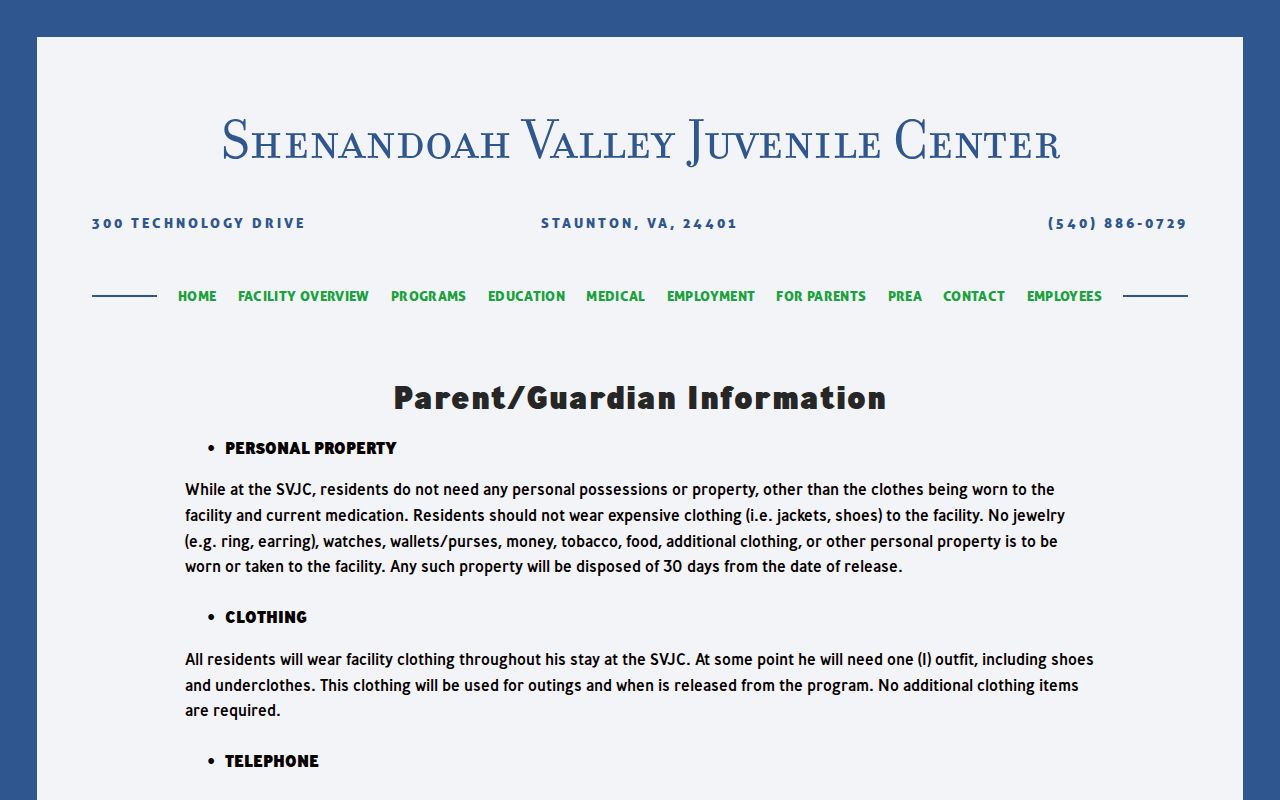
The parent guidance should be followed together with the court or placing agency’s instructions.
Shenandoah Valley Release Property
SVJC warns that property left after release may be disposed of after 30 days. An authorized parent or guardian should confirm what property remains, how pickup is arranged, who may receive it, and what identification the center requires. Act within the facility’s stated period rather than assuming items will remain indefinitely.
Property return and legal release are distinct. A property pickup can occur after the custody event and does not establish the date or terms of the court action. Keep an authorized copy of the order or agency notice for release proof, and keep property communication only for the belongings issue.
| Question | Correct source |
|---|---|
| Who controls release? | Juvenile court or placing authority |
| What clothing is needed? | SVJC parent and guardian instructions |
| How is property returned? | SVJC through an authorized contact |
| What happens to old property? | SVJC says it may be disposed after 30 days |
| Can an adult roster confirm the event? | No; adult systems do not supply this youth record |
Note: Property handling is a release-day task, but it is not the legal record that authorizes or proves release.
Shenandoah Valley Release Transportation
The parent information states that public transportation is not available to the center. An authorized parent, guardian, or placing agency should plan the approved trip in advance and confirm the pickup method with SVJC. Do not assume the transit options near downtown Staunton extend to Technology Drive.
Transportation plans must follow the court or agency’s release direction. A youth may be released to a specified adult or sent to another authorized placement. The center should confirm logistics only to a person allowed to receive them. No public waiting-area details or universal release time were established in the research, so none should be promised.
Weather, an amended order, another authorized placement, or unresolved logistics may affect the practical handoff. The legal authority remains the court or placing agency. Confirm the final event through that record, not through observation near the facility.
Shenandoah Valley Record Boundaries
Adult release records can include booking identifiers, release time, disposition, and a photo. Those public-record examples must not be copied onto a juvenile request. Juvenile confidentiality may restrict identity, allegations, medical details, family information, placement, and the very fact of detention. Ask only through the process that applies to the requester’s role.
The Augusta County adult release search is limited to adult MRRJ, state, court, VINE, and federal routes. It is not a way around SVJC safeguards. Likewise, the neighboring Middle River Regional Jail page applies to adult regional-jail custody and should not be used for a youth.
- Placing authority
- The court or agency legally responsible for a youth’s detention or placement.
- Authorized requester
- A person whose role and law permit access to confidential information.
- Release order
- The controlling court or agency action, not a public roster change.
- Transfer
- Movement to another approved placement, not necessarily return to the community.
Confirm Shenandoah Valley Records
Keep the sources separate. The court or placing agency supplies the legal action. SVJC supplies authorized facility logistics, clothing, property, and the completed handoff information it may disclose. Counsel interprets the order and can address access questions. A parent or guardian should use the paperwork and contacts already supplied in the case.
If an adult public tool returns a similar name, do not join that record to the youth. Names alone are weak identifiers, and disclosing a youth’s identity through a false match can cause harm. Resolve any discrepancy through the confidential case channel. The absence of a public profile is the expected condition for SVJC, not evidence that records do not exist.