
Augusta Scheduled and Actual Release
A scheduled date describes what should happen under the current sentence computation. The actual date records what did happen. VADOC may display a future release date while the person remains at a prison, in a local jail under state authority, or in another covered placement. MRRJ can hold a person whose date depends on a court order or local calculation. Neither a future locator date nor a parole grant proves that the exit occurred.
VADOC states that a qualifying physical release occurs by 11:59 p.m. on the release date, weather permitting. Staff provide and witness the applicable Order of Release, Conditions of Probation, or Conditions of Parole. A detainer can direct the person to another custodian. In that case, VADOC release does not mean arrival in the community.
- Projected date
- A date computed under current sentence and credit information.
- Parole eligibility
- The first point when an eligible sentence may be considered, not a grant.
- Mandatory parole date
- A statutory date for an applicable sentence, subject to the full record.
- Actual release
- The completed physical custody event shown by agency records.
- Detainer
- A hold that sends the person to another authority after one term ends.
Find Augusta County Release Dates
The useful source turns on legal status. A pretrial MRRJ detainee has no sentence-credit projection because the court or magistrate controls bond, recognizance, dismissal, and other release orders. MRRJ processes the actual exit. A person serving a local misdemeanor term may have a jail calculation. A state-responsible person requires VADOC Time Computation and the locator. Federal dates belong to BOP, not VADOC.
- Identify the booking, sentence, likely custodian, and whether the date sought is projected or actual.
- Check the MRRJ current roster once to determine whether local custody is still shown.
- For a state person, search the VADOC locator by seven-digit DOC ID or matched name fields.
- For a local sentence, request MRRJ’s existing computation and release fields, then compare the commitment order.
- Check the relevant Augusta court for an amended, vacated, bond, or release order.
- Near the date, confirm with the custodian and preserve the actual release event or signed document.
The broader Augusta County release-record search explains how a roster disappearance can also mean transfer. If VINE notification is appropriate, the VINELink Inmate Search explains the separate local and state registration paths.
Who Computes Augusta Release Dates
VADOC’s Time Computation page routes active Earned Sentence Credit terms longer than 12 months and applicable parole-eligible or Good Conduct Allowance sentence combinations. Short Augusta local sentences can remain with MRRJ and local authorities. A court controls the sentence imposed, while the jail or VADOC applies jail credit and the governing earned-time system.
| Augusta situation | Date source | What may supersede it |
|---|---|---|
| Pretrial MRRJ detention | Magistrate or court order; MRRJ actual exit record | Bond review, dismissal, new hold, or transfer |
| Local misdemeanor sentence of 12 months or less | MRRJ commitment and credit computation | Mandatory minimum, rule violation, amended order, or another hold |
| Post-1994 felony ESC term over 12 months | VADOC Time Computation | Credit class, forfeiture, jail credit, sentence structure, court correction, or detainer |
| Older parole-eligible or GCA term | VADOC and Virginia Parole Board | Conduct class, Board action, other sentences, or statutory rules |
| Federal sentence | BOP locator | Recalculation, court action, credit, or detainer |
The captured official computation source shows why local and state cases cannot be placed under one formula.
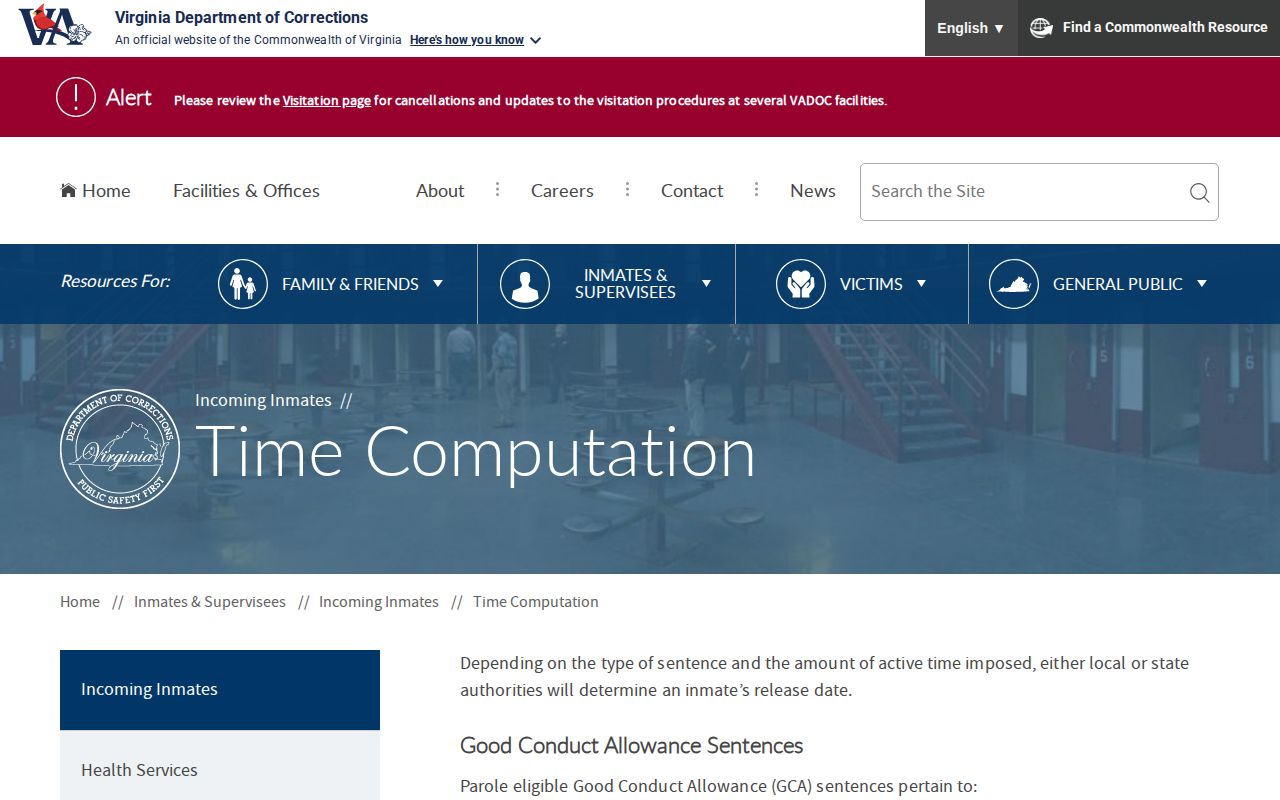
The routing choice comes first. Only then should a date be interpreted.
Note: A court sets the term, but the responsible jail or VADOC applies credits and records the resulting date.
Augusta VADOC Release Date Lookup
Use the VADOC Inmate and Supervisee Locator for a person held or supervised under state authority. Enter the seven-digit DOC ID when possible. The name route needs at least the first three letters of the first name and the full last name; location, age, race, and gender can narrow the match. The locator is updated daily and warns that information may be inaccurate or old.
Read location and status before interpreting the date. A prison or regional-jail result means continuing custody. A probation or parole district means community supervision. The public locator says applicable results may show a release date, but the exact on-screen label should be copied rather than renamed. A future date is a projection in context, even if the screen uses the shorter words “release date.”
Operating Procedure 050.1 identifies projected parole-eligibility, mandatory-parole, good-time release, custody or parole status, and facility location as correctional status fields that may be released on written request, subject to restrictions. Procedure 010.3 tells staff to confirm a projected date when asked. If the locator is blank or unclear, a narrow written status request is stronger than guessing from absence.
Augusta Jail Good-Time Rules
Virginia Code §53.1-116 requires the jailer to keep confinement records and a written earned-credit policy. For a person serving 12 months or less for a misdemeanor or group of misdemeanors, the statute provides one good-conduct day for each day served while the person follows jail rules, including qualifying pre-conviction jail time, unless a mandatory minimum applies. It also addresses certain added work, class, or institutional credits where available.
That rule must not be reduced to “every short sentence is cut in half.” A mandatory minimum, misconduct, jail credit, sentence structure, amended order, extra hold, and the jail’s lawful policy all affect the date. MRRJ should supply the existing computation or status field for the identified booking. The Augusta court record supplies the commitment and any later change.
The captured Virginia local-jail credit statute provides the exact rule used for the Augusta jail path.
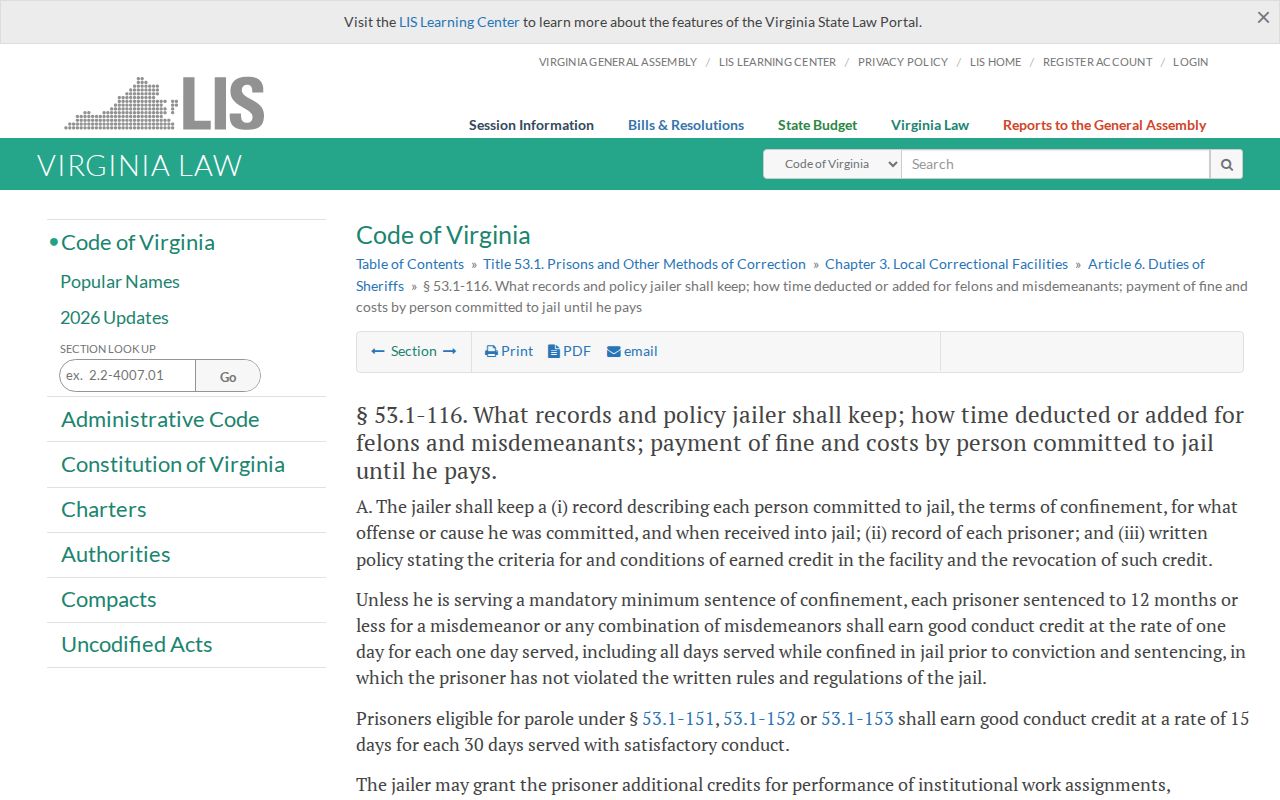
The statute supports a records request, but it does not compute a person’s date without the full sentence file.
Augusta State Earned Credits
Virginia abolished ordinary discretionary parole for most felonies committed on or after January 1, 1995, subject to statutory exceptions. Active post-1994 felony sentences generally use Earned Sentence Credits. Under §53.1-202.2, one earned credit deducts one day from incarceration. Section 53.1-202.3 then sets categories and rates. Listed serious offenses in subsection A are capped at 4.5 credits per 30 days served. At that maximum, 30 served days plus 4.5 credits satisfy 34.5 sentence days, about 86.96 percent actual service.
Other eligible subsection B terms may earn from zero to 15 credits per 30 days based on classification. Eligibility for a high rate does not prove that it was earned. Credits remain conditional and may be forfeited under the criteria required by §53.1-202.4. Section 53.1-202.3 also prevents earned credits from shortening the period needed before parole eligibility, so a person can have different projected release and parole-eligibility dates without a conflict.
The earned-credit rate statute is captured below.
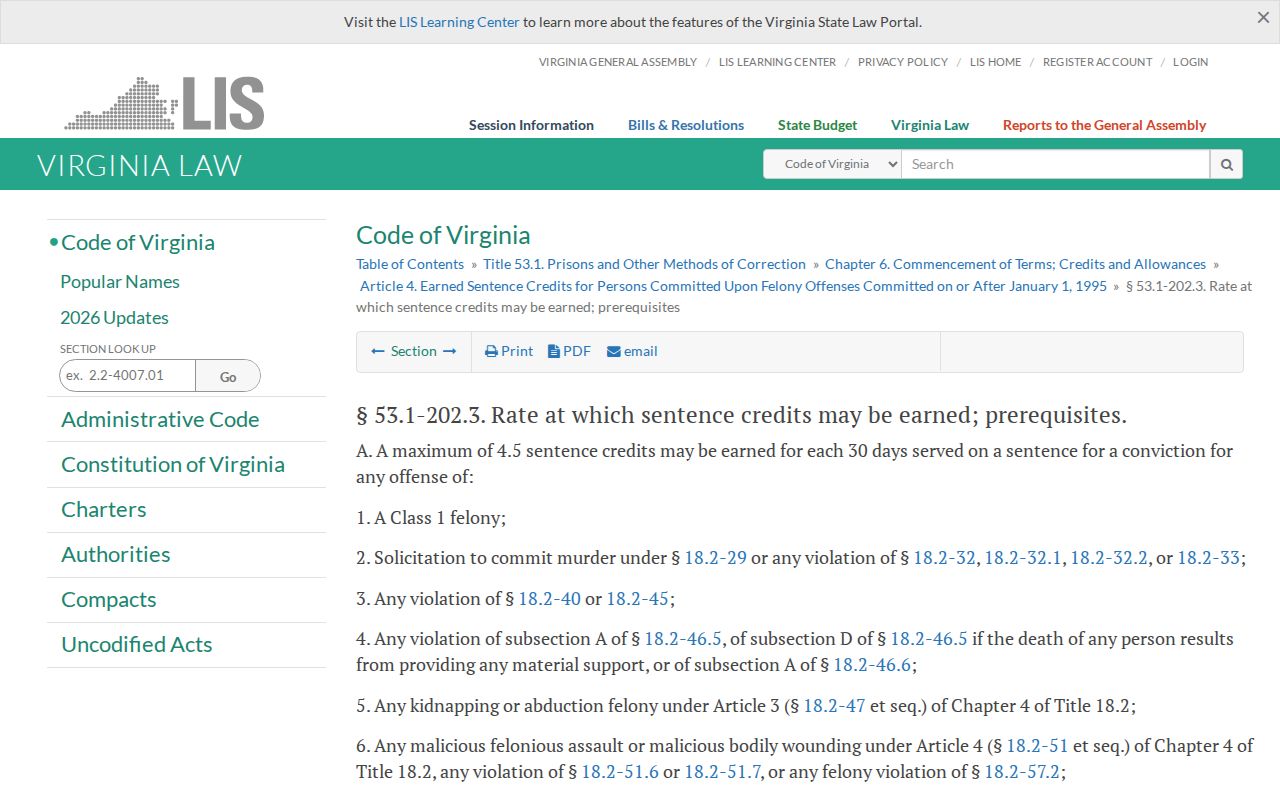
Use the live statute and VADOC’s actual classification record. The common “85 percent” phrase is only a broad summary and is not universal.
What Changes Augusta Release Dates
A projection changes when an input changes. The shift may be lawful and routine rather than an error. Compare the old and new label, the check dates, and the agency that made the calculation. Never recalculate a sentence from a short online summary.
| Factor | Possible effect | Best confirmation |
|---|---|---|
| Pretrial jail credit | Counts qualifying time already served | Commitment order and computation record |
| Concurrent or consecutive terms | Changes how multiple sentences combine | Court orders and VADOC calculation |
| Credit class or forfeiture | Raises, lowers, or removes earned days | VADOC or jail credit record |
| Amended or vacated order | Changes the legal sentence input | Current court order |
| Parole action | Creates a decision stage, not an instant exit | Board report plus later VADOC release record |
| Detainer or hold | May cause transfer after one term ends | Releasing and receiving agency records |
For a calculation dispute, VADOC lists the Correspondence Unit/Court & Legal Section at P.O. Box 26963, 6900 Atmore Drive, Richmond, VA 23261. Provide the DOC ID, the date label in question, and the specific issue. VADOC, MRRJ, and the committing court each control different parts of the record.
Parole adds another decision chain. Eligibility permits review but does not set an exit. A Virginia Parole Board grant is followed by notice, VADOC planning, review of other holds, and the later physical-release process. Monthly Board reports can show Grant or Not Grant, while the rolling public-meeting page records the decision stage. Neither source replaces the actual VADOC event. When an older parole-eligible sentence is involved, compare the Board action, mandatory-parole or good-time calculation, and the signed conditions before describing a date as final.
Note: Preserve the source, check date, and exact label whenever a projected date must be compared over time.
Confirm Augusta Actual Release
Check again near the date, then obtain positive evidence. For MRRJ, that may be the release sheet, the court disposition, and a person-specific Jail VINE event. For VADOC, the notification-of-release letter and signed Order of Release or Conditions of Parole or Probation establish the completed event more clearly than an old projection. If a detainer applied, identify the receiving custodian before describing the person as back in Augusta County.
For written state status, use VADOC FOIA routing and ask for the actual physical-custody release date, whether the event was discharge, parole, or transfer, the releasing facility, and any releasable release notice. For MRRJ, identify the booking and request the existing date and disposition fields. A narrow request is faster to understand and less likely to confuse two custody episodes.
Record the time of the final check and the exact agency label. A VINE notice is useful evidence that the feed processed a change, but it is informational. A court disposition can explain the legal basis without showing the jail’s exit time. When those sources differ, give priority to the custodian’s actual release record and ask that office to explain its own discrepancy. Do not turn silence, a delayed locator update, or disappearance from a roster into a date.